Lost in Trans-lation: Faris, Gender, and Localization
February 9, 2026
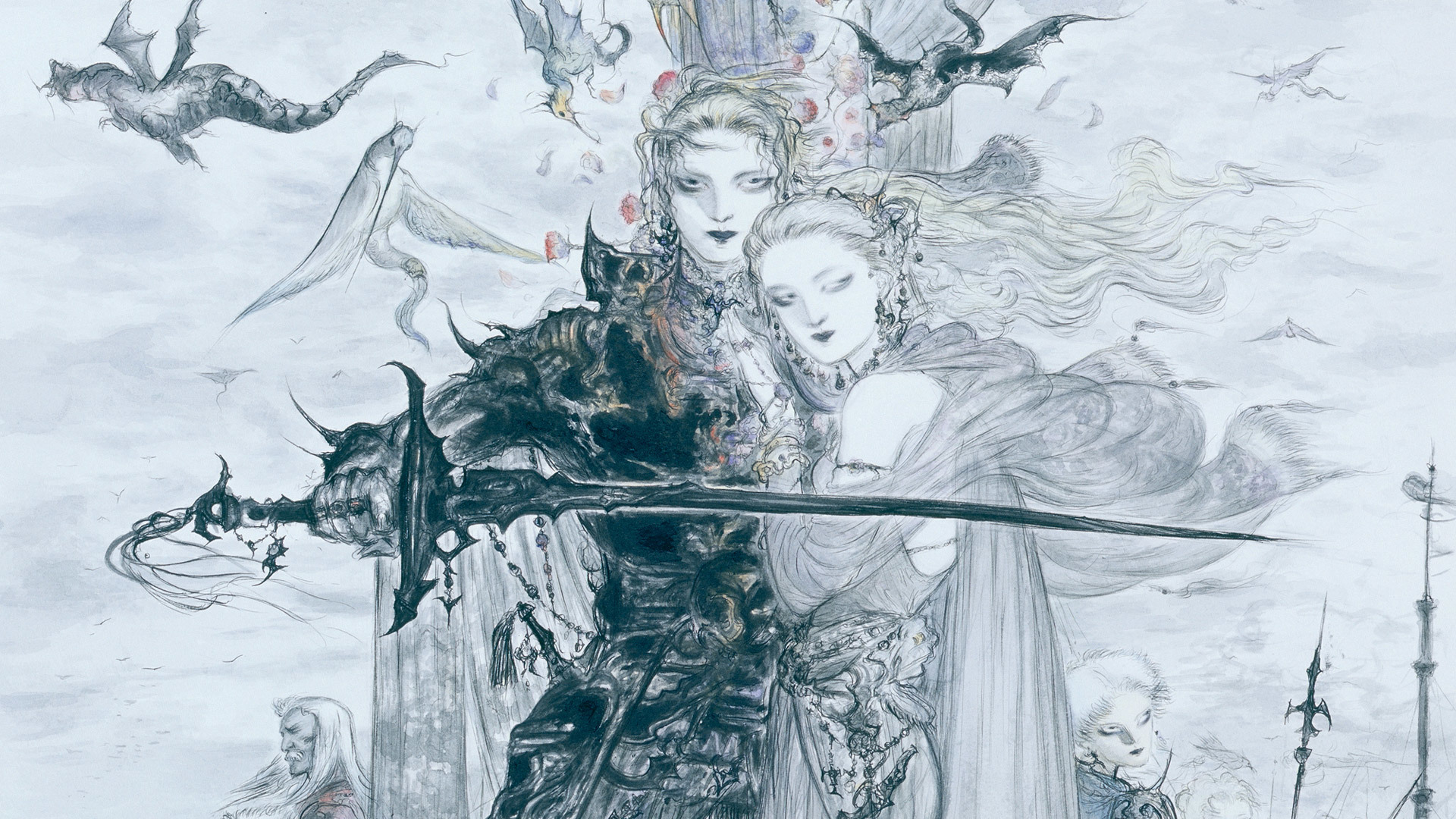
In an excellent article on Final Fantasy Tactics, Chuck Sebian-Lander champions the original 1997 translation as the most successful English-language treatment of the text to date. Despite the presumably more limited resources to spare for translation work in the mid-90s, the 1997 text captures a punchy brusqueness that prioritizes just saying the thing. Chuck compares this treatment favourably to the War of the Lions version, observing that by this point the text has become too aware of itself and is now trying to telegraph emotional beats that disrupt in-the-moment character writing.
Chuck does not pay much mind to WotL's affectation of a faux-Early Modern English register, which is probably the one thing you know about that version of the text if you only know one thing about it. His focus is on the characters.
I've got a similar bone to pick with Final Fantasy V, or maybe it's just a sliver of bone. I think as time has passed and the game has been localized and re-localized, the English-language text has done a poorer and poorer job representing my favourite character in the game: Faris.
Let me explain.
Final Fantasy V is one of the most translated and re-translated games in Square Enix's catalogue. Originally released in Japan for the Super Famicom in 1992, it received a Fan Translation by the group RPGe in 1998, a separate official localization for the PlayStation in 1999, a complete re-translation for the Game Boy Advance in 2006, and subsequent mobile (2013) and PC (2015) re-releases that have made further amendments to the GBA translation, up to and including the most recent and multiplatform Pixel Remaster (2021). For all of that legacy, however, the game was not officially localized for English-speaking audiences on its original SFC release.
Faris Scherwiz is one of the main party members in FFV--the fourth of five. He is introduced as a coarse and brash pirate captain, who loves his beer as much as he does his alone time. The rest of the party meet him very early in the game when they try to steal his ship. While Faris initially throws them in the brig for attempted Grand Theft Naval (understandable), he has an overnight change of heart and joins their cause.
What follows from here is a largely episodic structure which dominates the first act of the game--the party has a series of smaller-scale adventures as they journey to protect the crystals, which are under threat by a heretofore unknown force.
Then we get to the Ship Graveyard.
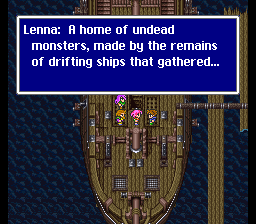
Structurally, the Ship Graveyard is a dungeon. I'd consider it the third one in the game, after the Pirate's Cave and the Wind Shrine. The Graveyard consists of a mass of wrecked ships adrift at sea, connected by collapsed masts and stepping stones. Part of the puzzle of traversal involves navigating submerged sections as the player threads their way through the maze. Narratively, this means the characters get wet, and so when they reach a mid-level checkpoint, a cutscene ensues where they make camp and dry their clothes.
How this scene plays out differs in small but significant ways across different versions of the game's script.
I'll start with what's common across texts. Midway through the graveyard, the party discovers a relatively safe, comfortable, and dry cabin. They agree to make camp and Lenna/Reina (some names change across localizations)--the sole woman in the party--retires to a private room to dry her clothes. This leaves the other three characters in a common area, where they make a fire. Two of them--Butz/Bartz and Galuf--prepare to dry their clothes, and implore Faris to do the same. Faris refuses to disrobe in front of the others, but Bartz and Galuf persist. This leads to a physical altercation, whereupon Faris fights both men off with ease, but not without a secret being revealed to the party--Faris is AFAB (Assigned Female at Birth).
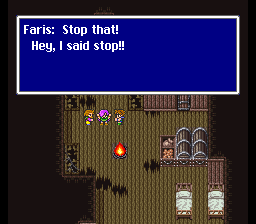
Okay, timeout. By contemporary standards, this writing is a bit hack. The gender reveal twist is an old trope and its deployment here is clumsy. If you're any kind of genderqueer, maybe you're experiencing flashbacks to some version of the "bathroom problem". Originally popularized by Jack Halberstam, the bathroom problem identifies gender-segregated public bathrooms as sites where gender norms are intensely scrutinized, perpetuated, and policed. For a person who doesn't fit comfortably within a traditional gender binary, the question of which bathroom to use is complicated by questions of performance, passing, and personal safety.
Basically, Faris does not wish to disclose to the party that he's got breasts. Bartz and Galuf respond by violating Faris' bodily autonomy and are rewarded for this behavior by getting knocked upside the head, but the damage is done. Faris performs one gender, but his companions now see another. He has been forcibly outed.
I'm not the first person to have written about Faris' genderqueerness. For a much more elegant reading arguing that Faris is explicitly a nonbinary trans man, I would direct you to this article from Arhys Hiraeth, taking the GBA version of the game as a foundation for their read. Here, I'm interested in expanding the scope of inquiry to account for the different versions of the Ship Graveyard scene across various English-language translations of the game.
The Fan Translation from 1998 has a reputation for being the most straightforward adaptation of the Japanese text, and rarely embellishes upon it. Faris explains that, having been raised from a young age by pirates, a masculine identity was necessary to command their respect. In this rendition, Butz expliclty insinuates that Faris was "pretending" to be a man, which Faris does not deny, only asserting defensively that being "female" doesn't make them less important.
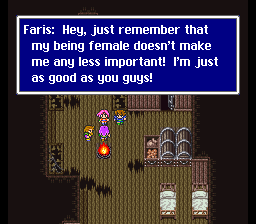
An interesting coda to this exchange, appearing in various forms across all translations, is Galuf's lingering suspicion about Faris' gender. Here, he asserts that Faris still "seems like a man."
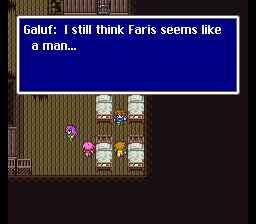
The PlayStation version from 1999 has a negative reputation. Beyond having a couple of new bugs and poor sound quality, the game's English-language translation--an official production arguably in direct competition with the fan project at the time--was derided for being poorer in quality than the Fan Translation. One element singled out for particular ridicule is the game's approach to Faris, who speaks in a stereotypical pirate dialect.
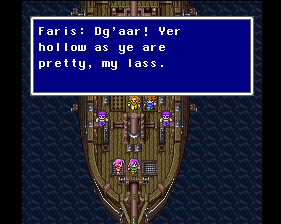
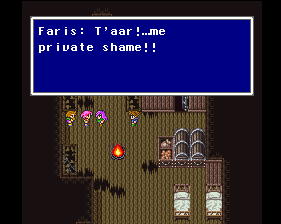
The PlayStation version holds consistent with many details in the Fan Translation--Bartz still accuses Faris of "pretending" to be a man, and at various points Galuf asserts both that Faris is "too pretty" to be a man but also that he still "seems like a man." But there are also interesting details in this translation that don't appear in any other version of the game. In the scene where Faris is confronted, for example, they reveal that their gender identity is a source of shame. Here I draw the implication that Faris' masculine identity is more than just a performance out of political necessity among pirates. Here, I would argue, we find the first hint that Faris might experience dysphoria.
In contrast to the straightforwardness of the Fan Translation and the talk-like-a-pirate affectation of the PlayStation version, the GBA translation of 2006 was well-received at the time for dropping the accent and instead taking new liberties with the text by including memes and pop-cultural references and jokes, many of which would likely leave a current-day player scratching their head. But more difficult for me is the way the game makes Faris the butt of jokes throughout the script for their crossdressing behavior.
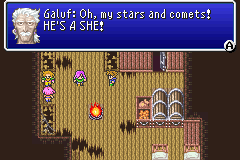
Even in this translation, however, we gain interesting new details. Where in other translations Faris offers less resistance to being called a woman, here he is more ambivalent, referring to themselves as both lad and lass.
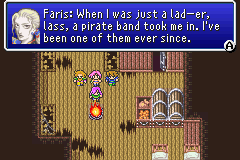
One detail I particularly do not love from this version of the text is Galuf's contribution, which moves from general questioning of Faris' gender in either direction to sexual harassment and policing of Faris' gender presentation. Overall, the GBA translation offers both the most possibility for Faris' gender-questioning, but also the most forceful punishment for that questioning. For this reason I think it's the most poorly aged translation of the three.
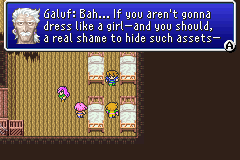
So that's three translations, three different readings of how Faris feels about their gender. But is any of them canon?
At this point you might reasonably argue than in instances of disagreement among translations, we ought to defer to the original Japanese text for matters of canon. Okay, let's run with that. In the original Japanese Super Famicom release of 1992, when Faris is initially confronted, he says ore-wa ii-yo, which translates to "I'm good."
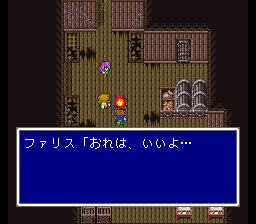
The same physical altercation described earlier plays out. Bartz tells Reina, "That guy-" and Galuf finishes, "Is a woman!"
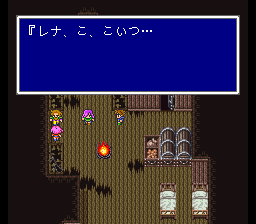
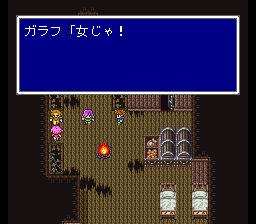
Much of the rest of the conversation plays out in similar fashion to other versions. Butz raises the idea that Faris is pretending to be a man, but in a more interogative tone. Faris' explanation that they were raised by pirates and had to assume a masculine identity to maintain their respect is likewise similar. But there's a small detail here, difficult to translate, that matters for our purposes. Faris uses the personal pronoun ore.
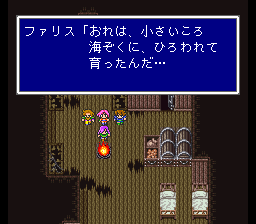
Ore in Japanese is very informal, carries an undercurrent of camaraderie, and is usually masculine. You can trace a rough arc from when a young boy primarily refers to himself with "boku", to when he starts to come of age and begins to assert his manhood with "ore". It's a pronoun you might use when you're hanging out with the lads. I don't have the cultural context to know decisively if "bro" is even roughly equivalent in English (they do after all serve different grammatical functions), but I can say with confidence you wouldn't use either in conversation with your boss.
Faris is introduced as using this pronoun regularly, continues to use ore after the reveal, and never drops it through the remainder of the game.
Is this a smoking gun? No. There are examples of women characters in Japanese media who use "ore", and this usually serves to mark them as tomboyish figures or characters who otherwise project a level of bravado beyond the scope of stereotypical femininity. Those characters, however, are uncommon, and are already subverting conventional gender roles.
What "ore" does demonstrate is that Faris' complicated gender feelings are not an invention of any particular localization process. Judith Butler emphasizes both the verb-ness and bidirectionality of gender as performance--it is at once something we do, in our own actions and decisions, and something that is done to us, as the societies in which we live work tirelessly to make those decisions for us. It seems, to me at least, there's no single canonical way to assign Faris a binary gender. They don't just disrupt gender binaries; they disrupt language binaries and canonicity binaries.
In the end, the questions Faris introduces are more important than any one answer we can assign them. The game itself, across multiple translations, seems to recognize this as the intermission in the Ship Graveyard draws to a close. "Faris is Faris!" reads the Fan Translation, which I would learn many years later was in fact spearheaded by a trans woman.
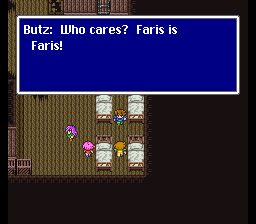
The PlayStation version delivers the same translation.
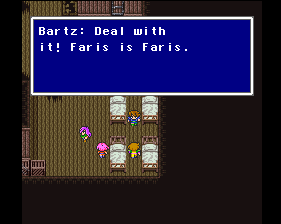
The original Japanese affirms this rallying cry word-for-word: "Farisu-wa Farisu da!" (Faris is Faris!).
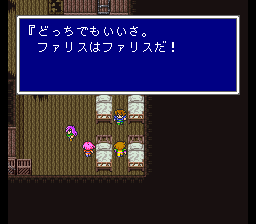
Only the GBA translation insists on spoiling the moment by forcibly gendering the character. You see now why this one is my least favourite?
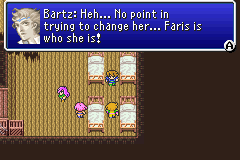
And the more recent translations derived from this script carry this detail forward. Is this a less than happy ending for Faris? Perhaps. Yet the multiplicity of translations of this game and others points to an alternative possibility, of further fan translation and re-translation, of reinterpretation, of fandom, of fanon, of mods, of making our own stories.
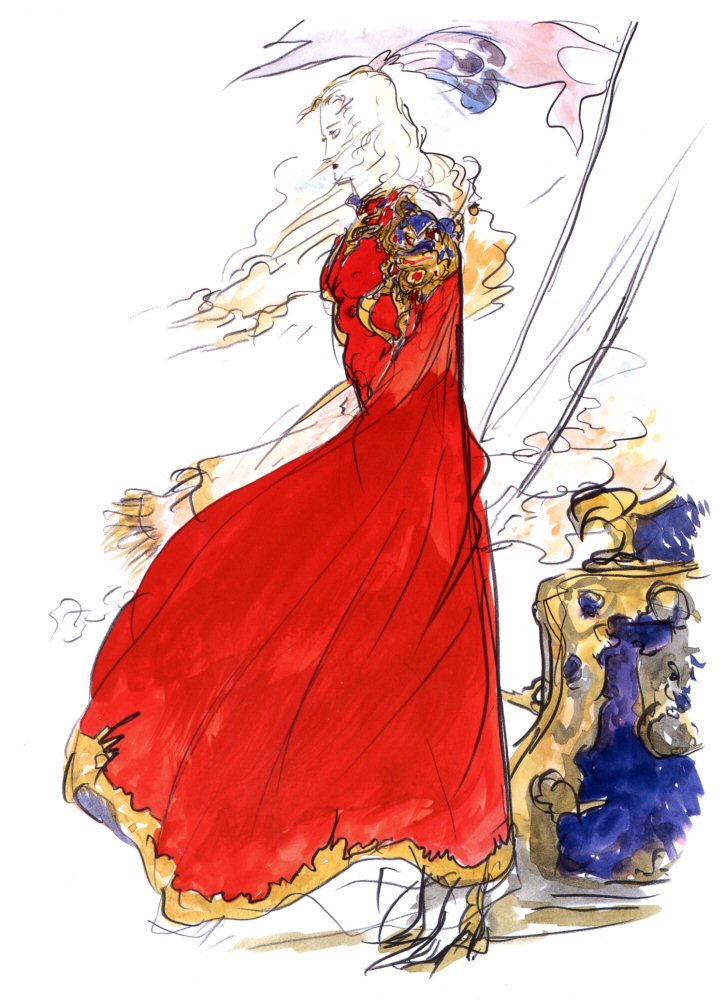
The main cast of Final Fantasy V are archetypes. Faris, the pirate captain, is more free-spirited anarchist than pillaging mercenary, landing closer to the territory that One Piece would continue to chart out a few years later. As a character Faris has spoken to me, moved me, across years, across phases in my life. By interrogating gender binaries, they interrogate the binaries that govern games writing, translation, and canon. Faris was my first nonbinary digital storyteller.
References
Butler, J. (1988). Performative Acts and Gender Constitution: An Essay in Phenomenology and Feminist Theory. Theatre Journal, 40(4), 519-531.
Halberstam, J. (1998). Female Masculinity. Duke University Press.
Hiraeth, A. (2020, January 8). Sailing the Queer Seas: Final Fantasy V, Faris, and Gender. First Person Scholar. https://www.firstpersonscholar.com/sailing-the-queer-seas/
Sebian-Lander, C. (2024, February 25). on translations: blame yourself or god. final fantasy tactics is the only good final fantasy. https://write.as/final-fantasy-tactics-is-the-only-good-final-fantasy/on-translations-blame-yourself-or-god
